
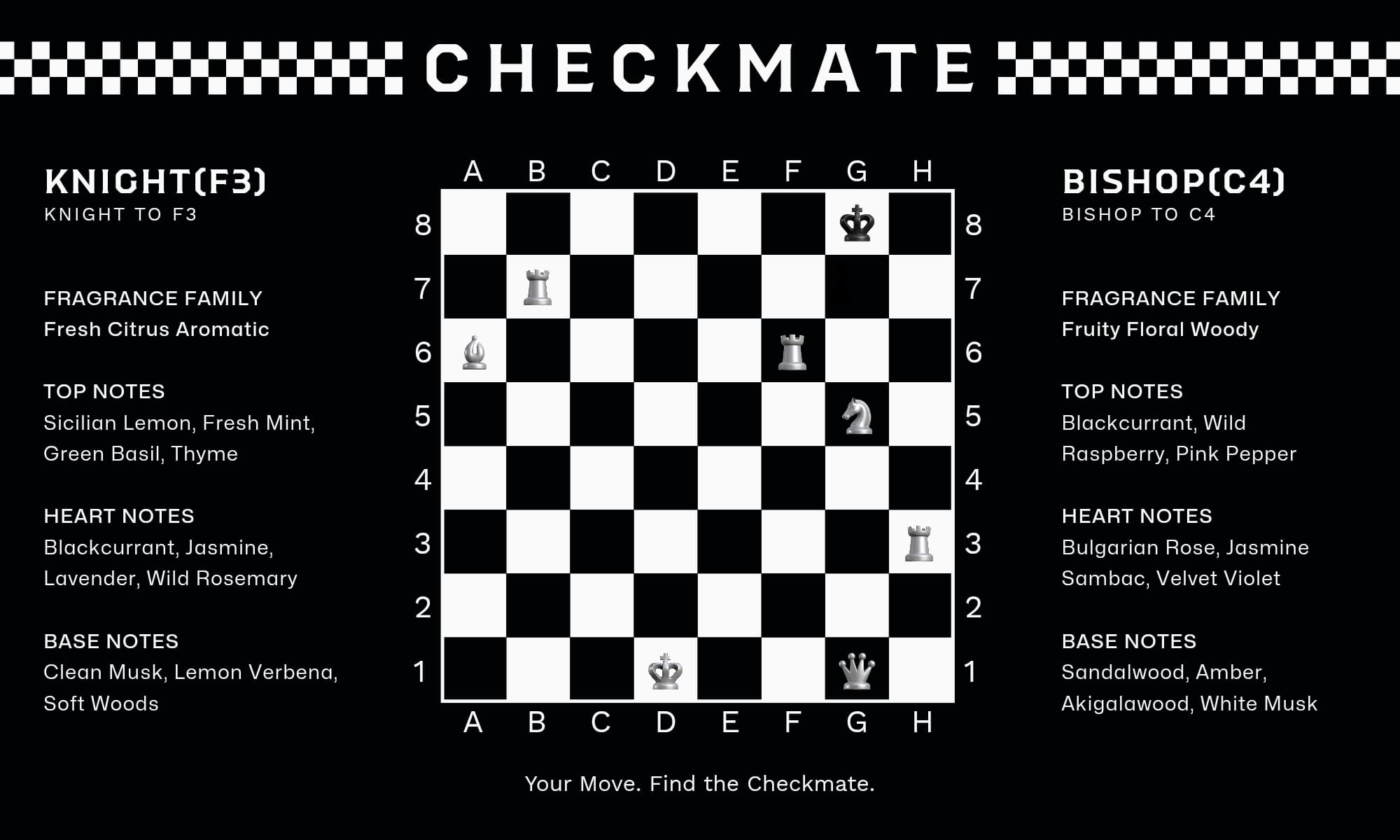
Every Edition of the house begins with a problem, and the problem is always the same: how do two fragrances share one world without sharing a voice? For Dusk — the inaugural Edition — the brief was to open the house at its two outer edges. One composition for the day a man wants to be underestimated. One for the evening he does not. Two moves from the same opening position.
01The Opening Position
In chess, the first moves are not about winning. They are about declaring intent. Knight to f3 develops a piece and controls the center without committing the structure. Bishop to c4 does the same from the opposite flank — longer range, different geometry, same ambition. The two moves are compatible, often played in the same game, and yet no one would confuse one for the other.
That was the architecture of the Edition. Knight(F3) and Bishop(C4) would be composed to the same standard, at the same 25% concentration, inside the same box — and they would disagree about everything else.
02Knight(F3) — The Unpredictable Move
The knight is the only piece that arrives where it cannot be predicted. It jumps. The brief for Knight(F3) was a composition with that same quality: fresh, but never simple; clean, but never sterile.
The opening is a citrus that behaves like a conversation rather than an announcement — Sicilian lemon cut with green basil and fresh mint, with thyme keeping the brightness from turning sweet. The heart does the unpredictable work: blackcurrant against French lavender, jasmine against wild rosemary — a pairing that should argue and instead resolves. The base is deliberately quiet: clean musk, lemon verbena, soft woods. The composition lands and then steps back, the way a well-played knight controls squares it no longer stands on.
Worn in the morning, it reads as effortless. Worn in the evening, it reads as intentional. It is the fragrance of a man whose plans are not yet visible.
03Bishop(C4) — The Long Diagonal
The bishop works along the diagonal — the longest unobstructed line on the board. Its power is distance and clarity. Where Knight(F3) unsettles, Bishop(C4) declares.
This composition opens bright and juicy: pineapple and mandarin sharpened with cardamom — a top that announces itself the way a bishop announces a line the moment it is developed. The heart is the Edition's driest material: iris kept cool by vetiver and juniper berry — composed without softness, masculine without effort. The base grounds the declaration in tree moss, guaiac wood and musk — mossy, smoky, and long.
If Knight is worn to keep a room guessing, Bishop is worn to end the guessing. It is the fragrance of a man who has decided what the evening will remember.
04The Two Compositions, Side by Side
| Knight(F3) | Bishop(C4) | |
|---|---|---|
| Family | Fresh Citrus Aromatic | Fruity Woody Chypre |
| Opens with | Lemon, mint, basil | Pineapple, mandarin, cardamom |
| Resolves to | Clean musk, soft woods | Tree moss, guaiac wood, musk |
| Worn when | The plan is not yet visible | The plan has been made |
| Plays like | A knight — indirect, unsettling | A bishop — direct, declarative |
05Why They Exist Only Together
The house is sometimes asked — gently, and then less gently — whether Knight or Bishop will ever be sold alone. The answer is the house's oldest position, and it will not change: the pieces exist within the game they were composed for.
This is not packaging strategy. It is composition strategy. Knight(F3) and Bishop(C4) were written against each other — each one completes the other's sentence. To separate them would be to publish the first and last chapters of a book and discard the middle. The Edition is the unit of the house. The Archive, when it comes for Dusk, will take them together, as it should.
The Dusk Edition is open. When it closes, these two compositions leave the board together — retired to the Archive, never reproduced. The house does not say this to hurry you. It says it because it is the founding rule of everything we make.